Funding rate
per settlement · below 0 %
- Funding
- low
- high
Who pays whom how much in futures. Perpetual futures have no expiry. To keep their price close to the coin’s price, one side pays the other at every settlement, usually every 8 hours. When the rate is positive, longs pay: many bet on rising prices on margin, and above “high” the market counts as overheated. When it is negative, shorts pay: many bet on falling prices, which can set off a short squeeze upwards. The node takes the coin of the chain’s first candle and shows the last settlement at every candle. Example: “funding above 0.05 %” with AND and “RSI above 70” reports an overheated rally.
What it looks like
Section titled “What it looks like”- Price (close of each candle)
- Funding
- below 0 % and above 0.008 %
Setting it in the chart
Section titled “Setting it in the chart”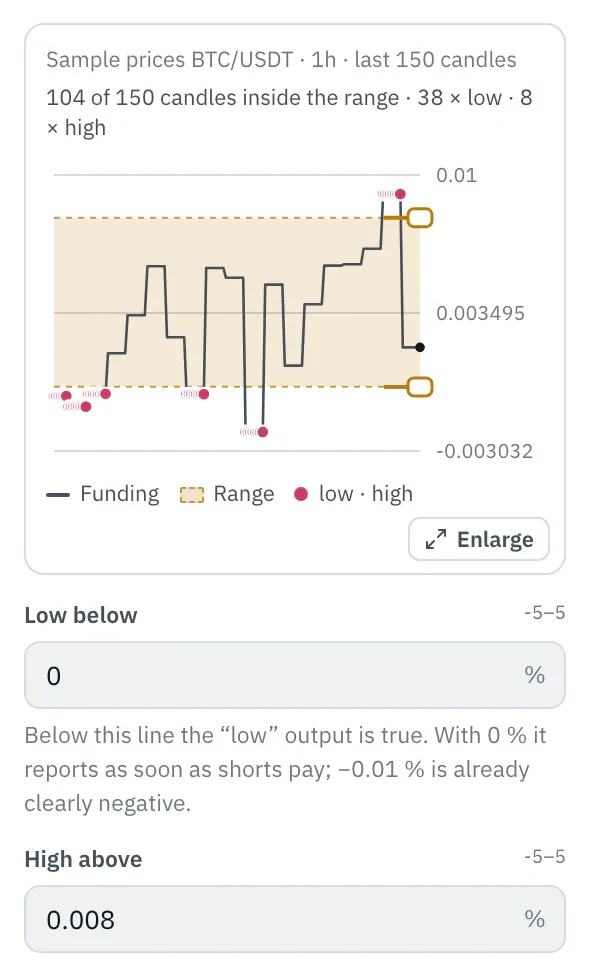
In the properties, a chart shows the last 150 candles with the zone between Low and High. Drag a limit or type the numbers; a limit that comes from another node can’t be dragged. The top line shows how many candles lie inside the range and how often the condition would be met.
More under Chart above the price.
Settings
Section titled “Settings”The settings appear on the right under “Properties” once you click the node on the board. Below each field you find the same explanation as here.
Low below
Section titled “Low below”Below this line the “low” output is true. With 0 % it reports as soon as shorts pay; −0.01 % is already clearly negative.
High above
Section titled “High above”Above this line the “high” output is true. 0.01 % per settlement is usual; from about 0.05 % the market counts as overheated, for small coins often only later.
Example
Section titled “Example”A simple example with this node.
How to connect the nodes:
- Funding rate (low) → Telegram (Trigger)
On the board it reads: per settlement · below 0 %
Chain as JSON
To try it, copy it and paste it in the editor under “Import”. Importing creates a new chain.
{ "name": "Example: Funding rate", "version": 1, "nodes": [ { "id": "x1", "type": "core.funding", "position": { "x": 40, "y": 40 }, "settings": {} }, { "id": "t1", "type": "core.telegram", "position": { "x": 260, "y": 40 }, "settings": {} } ], "edges": [ { "from": "x1.low", "to": "t1.in" } ]}Inputs and outputs
Section titled “Inputs and outputs”Only matching types connect: number series to number series (round pin), signal to signal (square), message to message (diamond).
| Direction | Pin | Type | Note |
|---|---|---|---|
| Input | – | – | No inputs: the data comes straight from the source. |
| Output | Funding | Number series | in percent |
| Output | low | Signal (true/false) | – |
| Output | high | Signal (true/false) | – |
Good to know
Section titled “Good to know”- In messages the value is called “Funding”.
- Search also finds it under: funding, funding rate, perpetual, perp, futures, derivatives, leverage, long, short, squeeze, overheated.
Technical details
Section titled “Technical details”Funding rate of the USDT perpetual on the coin of the chain’s first candle (BTC/USDT, BTC/EUR … → BTC), from one of the largest futures markets, in percent per settlement. At a candle the last settlement at least 5 minutes before its close applies; if it is older than 24 hours or there is no contract, the value stays empty. Contracts on 1,000 coins (such as PEPE) count like one.
- Type in the chain:
core.funding· Version 1.0.0 · Category keysrc - Settings in the chain:
low(Low below),high(High above) - Pins in the chain: Output
rate,low,high - Source: Funding rate from the futures market, loaded by the engine
- Reference tests in the manifest: 1 (with fixed price data: 500 candles of 1h)
- How a node is built
Version 2026.10.25.16 · Changelog