Fair value gaps
- Price
- High
- Low
up gaps · from 0.2 %
- Price enters gap
- Close in gap
- New gap
- Gap filled
- Top
- Bottom
- Filled %
Price gaps between three candles. Finds gaps a fast rise or fall leaves behind: if the low of a candle lies above the high of the one two before, no trade happened in between. Many traders expect the price to fill such gaps later. The node reports new gaps, the first return into an open gap, a close inside one and a completely filled gap, plus top and bottom of the nearest gap and how far it is filled. A gap is known with the close of its third candle. Example: up gaps from 0.2 % with “price enters gap” report when ETH falls back into the gap after a jump.
What it looks like
Section titled “What it looks like”- open gap
- partially filled
- below the minimum size
- Price enters gap
Setting it in the chart
Section titled “Setting it in the chart”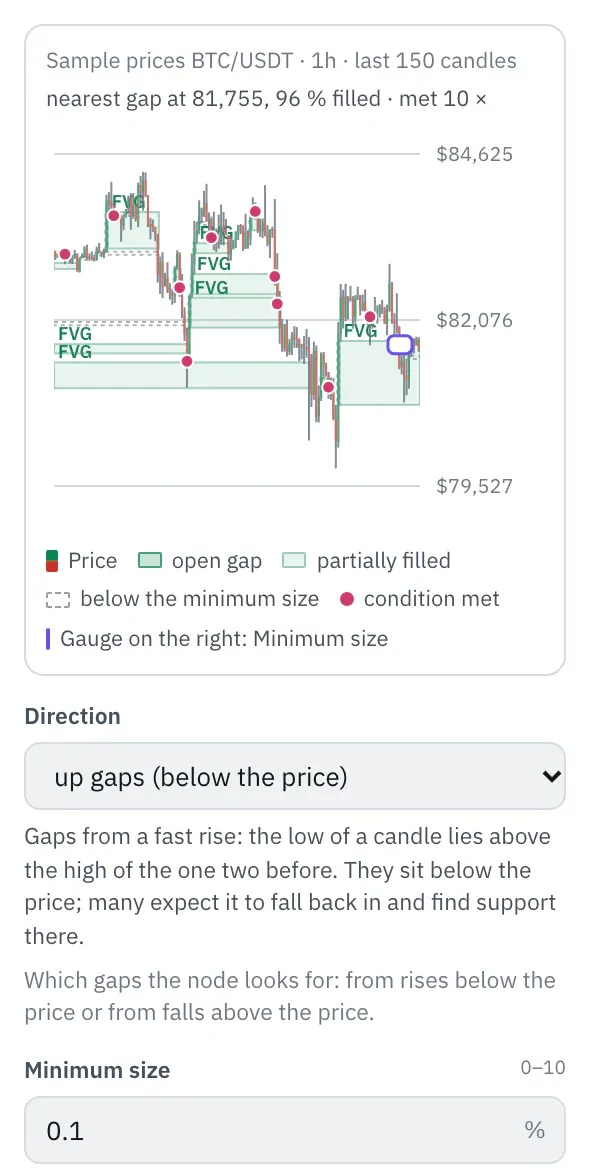
In the properties, a chart shows the last 150 candles and on top of them what the node finds with your settings; dotted or dashed is what it did not know yet at that time. The gauge at the right edge shows “Minimum size”; drag it vertically. The top line shows the state at the last candle, and the chart follows every setting right away.
More under Smart money and Chart above the price.
Settings
Section titled “Settings”The settings appear on the right under “Properties” once you click the node on the board. Below each field you find the same explanation as here.
Direction
Section titled “Direction”Which gaps the node looks for: from rises below the price or from falls above the price.
- up gaps (below the price) (default): Gaps from a fast rise: the low of a candle lies above the high of the one two before. They sit below the price; many expect it to fall back in and find support there.
- down gaps (above the price): Gaps from a fast fall: the high of a candle lies below the low of the one two before. They sit above the price; many expect it to rise back in and get rejected there.
Minimum size
Section titled “Minimum size”How tall a gap has to be at least, in percent of the price. Smaller ones do not count; the chart only shows their outline. For BTC on hourly candles half of all gaps are smaller than 0.12 %; on 4-hour candles 0.2 to 0.5 % fit.
Example
Section titled “Example”Notifies you when the price falls back into an open up gap of at least 0.2 %.
How to connect the nodes:
- Candle (Price) → Fair value gaps (Price)
- Candle (High) → Fair value gaps (High)
- Candle (Low) → Fair value gaps (Low)
- Fair value gaps (Price enters gap) → Telegram (Trigger)
On the board it reads: up gaps · from 0.2 %
Chain as JSON
To try it, copy it and paste it in the editor under “Import”. Importing creates a new chain.
{ "name": "Example: Fair value gaps", "version": 1, "nodes": [ { "id": "c1", "type": "core.candle", "position": { "x": 40, "y": 40 }, "settings": { "pair": "BTC/USDT", "timeframe": "1h" } }, { "id": "f1", "type": "core.fvg", "position": { "x": 260, "y": 40 }, "settings": { "minSize": 0.2 } }, { "id": "t1", "type": "core.telegram", "position": { "x": 480, "y": 40 }, "settings": {} } ], "edges": [ { "from": "c1.close", "to": "f1.close" }, { "from": "c1.high", "to": "f1.high" }, { "from": "c1.low", "to": "f1.low" }, { "from": "f1.enter", "to": "t1.in" } ]}Inputs and outputs
Section titled “Inputs and outputs”Only matching types connect: number series to number series (round pin), signal to signal (square), message to message (diamond).
| Direction | Pin | Type | Note |
|---|---|---|---|
| Input | Price | Number series | required |
| Input | High | Number series | required |
| Input | Low | Number series | required |
| Output | Price enters gap | Signal (true/false) | – |
| Output | Close in gap | Signal (true/false) | – |
| Output | New gap | Signal (true/false) | – |
| Output | Gap filled | Signal (true/false) | – |
| Output | Top | Number series | appears in messages as a price, e.g. “$81,616” |
| Output | Bottom | Number series | appears in messages as a price, e.g. “$81,616” |
| Output | Filled % | Number series | in percent |
Good to know
Section titled “Good to know”- In messages the values are called “top of gap ≥ 0.1 %”, “bottom of gap ≥ 0.1 %”, “gap ≥ 0.1 % filled”.
- Warm-up with the default settings: 502 candles (this many extra candles are loaded by the replay before the value is reliable).
- Search also finds it under: fair value gap, fvg, gap, imbalance, fill, retest, smart money, smc.
Technical details
Section titled “Technical details”Up gap at candle i: low[i] > high[i − 2], zone from high[i − 2] to low[i], size (top − bottom) / bottom × 100. Down gap: high[i] < low[i − 2]. Open until the first candle that reaches in (a low at or below the top), then partially filled; completely filled once a low reaches the bottom. After that, and after 500 candles, it no longer counts. “Filled %” is the deepest point since it formed, in percent of its height; the values refer to the unfilled gap nearest to the close.
- Type in the chain:
core.fvg· Version 1.0.0 · Category keyind - Settings in the chain:
side(Direction),minSize(Minimum size) - Pins in the chain: Input
close,high,low· Outputenter,inside,formed,filled,top,bottom,fill - Reference tests in the manifest: 1 (with fixed price data: 500 candles of 1h)
- How a node is built
Version 2026.10.21.23 · Changelog