Liquidity sweeps
- Price
- High
- Low
below lows · 10 · 10
- Sweep
- New equal swings
- Sweep level
- Next liquidity
Price takes liquidity and turns. Above swing highs and below swing lows sit many stops and orders, the liquidity. A sweep is a brief excursion beyond, after which the price closes back inside right away: the orders are taken, the breakout does not hold. If several highs sit at almost the same price (equal highs), especially much gathers there. The node reports sweeps and new equal highs or lows and gives the next level holding liquidity. A swing only counts once it is confirmed. Example: “below lows” reports when BTC spikes below the last swing low and closes back above it in the same candle.
What it looks like
Section titled “What it looks like”- Liquidity below swing lows
- Swing not yet confirmed
- Sweep
- EQL: equal lows
Setting it in the chart
Section titled “Setting it in the chart”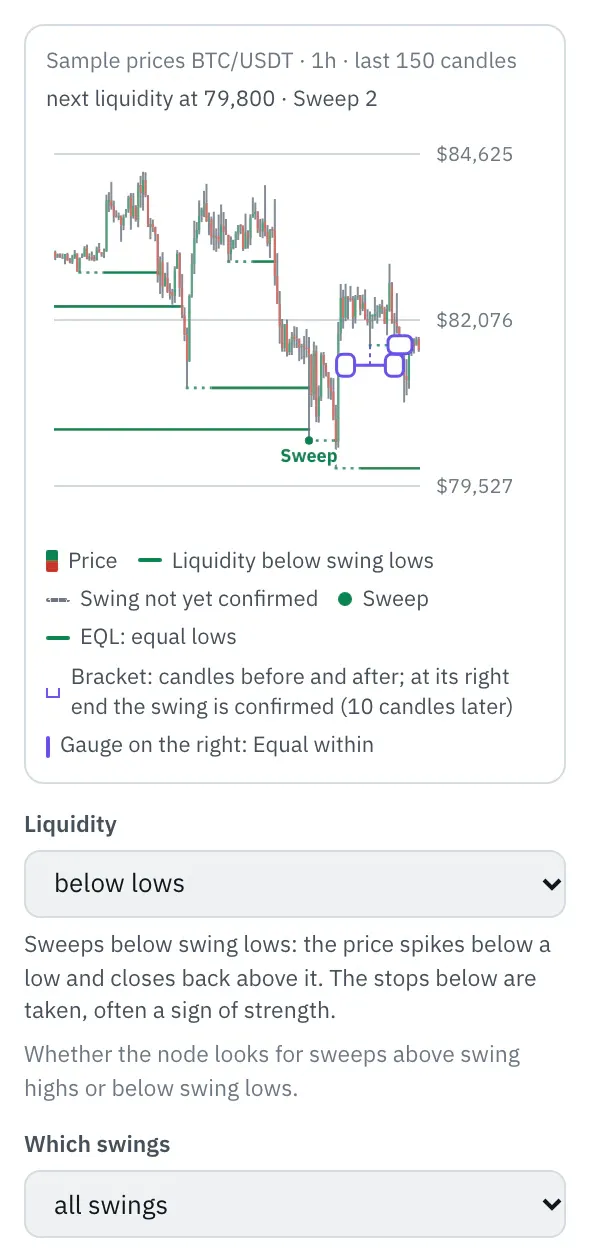
In the properties, a chart shows the last 150 candles and on top of them what the node finds with your settings; dotted or dashed is what it did not know yet at that time. Drag the ends of the bracket at the latest swing to change “Candles before” and “Candles after”; at its right end the swing is confirmed. The gauge at the right edge shows “Equal within”; drag it vertically. The top line shows the state at the last candle, and the chart follows every setting right away.
More under Smart money and Chart above the price.
Settings
Section titled “Settings”The settings appear on the right under “Properties” once you click the node on the board. Below each field you find the same explanation as here.
Liquidity
Section titled “Liquidity”Whether the node looks for sweeps above swing highs or below swing lows.
- above highs: Sweeps above swing highs: the price spikes above a high and closes back below it. The buy orders and stops above are taken, often a sign of weakness.
- below lows (default): Sweeps below swing lows: the price spikes below a low and closes back above it. The stops below are taken, often a sign of strength.
Which swings
Section titled “Which swings”Whether every swing counts or only places with equal highs or lows.
- all swings (default): Every confirmed swing high (for lows every swing low) counts as liquidity.
- equal highs and lows only: Only places where at least two swings sit at almost the same price. Rarer, but that is where especially many orders gather.
Equal within
Section titled “Equal within”How far apart two swings may be to count as equal, in percent of the price. 0.1 % is about $80 for BTC; with 0 only exactly equal ones count.
Return within
Section titled “Return within”Within how many candles the price has to close back inside. 1 means the same candle that spikes above the level closes back below it. With more candles, excursions that briefly close beyond count too.
Candles before
Section titled “Candles before”How many candles before a high must all be lower, before a low higher. With more candles only clearer turning points count.
Candles after
Section titled “Candles after”How many candles after a high must not rise above it before it counts as a swing. Only then does it count here, that many candles later; with fewer candles it counts sooner, but smaller turning points count too.
Example
Section titled “Example”A push when the price spikes below a confirmed swing low and closes back above it in the same candle.
How to connect the nodes:
- Candle (Price) → Liquidity sweeps (Price)
- Candle (High) → Liquidity sweeps (High)
- Candle (Low) → Liquidity sweeps (Low)
- Liquidity sweeps (Sweep) → Push (Trigger)
On the board it reads: below lows · 10 · 10
Chain as JSON
To try it, copy it and paste it in the editor under “Import”. Importing creates a new chain.
{ "name": "Example: Liquidity sweeps", "version": 1, "nodes": [ { "id": "c1", "type": "core.candle", "position": { "x": 40, "y": 40 }, "settings": { "pair": "BTC/USDT", "timeframe": "1h" } }, { "id": "w1", "type": "core.sweeps", "position": { "x": 260, "y": 40 }, "settings": {} }, { "id": "p1", "type": "core.push", "position": { "x": 480, "y": 40 }, "settings": {} } ], "edges": [ { "from": "c1.close", "to": "w1.close" }, { "from": "c1.high", "to": "w1.high" }, { "from": "c1.low", "to": "w1.low" }, { "from": "w1.sweep", "to": "p1.in" } ]}Inputs and outputs
Section titled “Inputs and outputs”Only matching types connect: number series to number series (round pin), signal to signal (square), message to message (diamond).
| Direction | Pin | Type | Note |
|---|---|---|---|
| Input | Price | Number series | required |
| Input | High | Number series | required |
| Input | Low | Number series | required |
| Output | Sweep | Signal (true/false) | – |
| Output | New equal swings | Signal (true/false) | – |
| Output | Sweep level | Number series | appears in messages as a price, e.g. “$81,616” |
| Output | Next liquidity | Number series | appears in messages as a price, e.g. “$81,616” |
Good to know
Section titled “Good to know”- In messages the values are called “Sweep below lows 10 · 10”, “liquidity below lows 10 · 10”.
- Warm-up with the default settings: 1,021 candles (this many extra candles are loaded by the replay before the value is reliable).
- Search also finds it under: liquidity, sweep, stop hunt, stops, equal highs, equal lows, eqh, eql, false breakout, smart money, smc.
Technical details
Section titled “Technical details”Every confirmed swing high is a pool. A new swing high at most “Equal within” percent from a pool no candle has reached yet joins it (equal highs); the level is the highest. Sweep: a candle rises above the level and it, or one of the candles up to “Return within”, closes below it; otherwise the pool counts as broken. A pool counts for 500 candles from its first swing. “Sweep level” lasts 500 candles. Lows mirrored.
- Type in the chain:
core.sweeps· Version 1.0.0 · Category keyind - Settings in the chain:
side(Liquidity),pools(Which swings),tolerance(Equal within),bars(Return within),left(Candles before),right(Candles after) - Pins in the chain: Input
close,high,low· Outputsweep,equal,level,pool - Reference tests in the manifest: 1 (with fixed price data: 500 candles of 1h)
- How a node is built
Version 2026.10.21.23 · Changelog